Best Air Purifiers for Dust Removal
Indoor dust looks harmless until a sunbeam turns it into a slow-moving cloud. Those particles are a mix of fabric fibers, skin flakes, soil, pet dander, and fine debris that can irritate allergies and settle back onto every surface you just cleaned. A capable air purifier helps by pulling suspended dust through dense filters before it has another chance to circulate. The trick is choosing a machine with enough airflow, realistic maintenance costs, and performance that fits your room rather than the box copy.
Not every purifier is equally effective against dust, because dust removal depends on filter quality, fan strength, room size, and how long the unit can keep air moving. Some machines are quiet but underpowered, while others clean quickly but are noisy at the speeds that matter most. To make the search easier, this article starts with an outline, then moves through performance basics, essential features, strong model categories, room matching, and a practical conclusion for buyers who want cleaner air without overspending.
Outline
• Why dust behaves differently from smoke and odors, and why airflow matters so much
• The purifier features that genuinely improve dust removal, including filters, CADR, and maintenance design
• A comparison of several standout air purifiers for different room sizes, budgets, and preferences
• How to size and place a purifier so it works well in real homes instead of just in product charts
• Final recommendations for renters, families, pet owners, and anyone tired of wiping the same shelf twice
Why Dust Removal Is Different From General Air Cleaning
Dust is easy to underestimate because much of it is visible only when the light catches it. In reality, household dust is a layered mixture of large and small particles. It often includes textile fibers, paper fragments, outdoor soil tracked in on shoes, skin flakes, pollen, pet dander, cooking residue, and tiny particles released from furniture and building materials. Some of those particles are relatively heavy and settle fast, while finer material can stay suspended longer and travel with your heating or cooling airflow. That difference is exactly why dust control requires more than a basic fan in a plastic shell.
An air purifier removes dust only when the dust reaches the machine. This sounds obvious, but it explains why purifier performance varies so much from home to home. A weak unit may have a decent filter on paper, yet still leave a room dusty because it cannot move enough air through the filter often enough. Think of it like sweeping one corner of a workshop and expecting the whole floor to shine. Airflow is the worker on the night shift; the filter is the tool it uses. Without strong, steady circulation, even a high-grade filter cannot catch what never passes through it.
Dust removal also differs from odor control. Odors are usually gases, which often require activated carbon or other sorbent media to reduce them. Dust is particulate matter, so the core solution is mechanical filtration. A true HEPA filter or a well-designed equivalent system captures airborne particles as air passes through dense media. HEPA is especially relevant because the standard is based on capturing 99.97 percent of particles at 0.3 microns, a size chosen because it is one of the most difficult to trap. Larger dust particles are often easier to capture than that benchmark, but the machine still needs enough airflow to keep the room air cycling.
For people shopping specifically for dust, the important lesson is that no purifier stops dust from being created. Bedding still sheds fibers. Rugs still release particles when walked on. Windows still invite outdoor material into the room. What a purifier can do is reduce the airborne share of that dust, which may mean less material landing on furniture and less particle exposure while you sleep, work, or relax. In practical terms, the best dust purifier is not just the one with the fanciest filter label. It is the one that combines strong air movement, reliable filtration, and room-appropriate capacity so suspended dust gets fewer chances to linger.
What Features Matter Most When Choosing an Air Purifier for Dust
If you want an air purifier that actually helps with dust, start with the filtration system and then work outward. The most useful baseline is a sealed design paired with a HEPA filter or a well-tested high-efficiency system. A sealed body matters because air takes the path of least resistance. If the housing leaks, some particles can bypass the filter entirely. That does not make a purifier useless, but it can reduce real-world performance. For dust, a washable or vacuumable pre-filter is also valuable because larger lint and hair can clog the main filter over time.
One of the most important numbers to compare is CADR, or Clean Air Delivery Rate. This rating estimates how quickly a purifier can reduce smoke, dust, and pollen in controlled testing. For dust removal, the dust CADR is especially helpful. A higher CADR generally means the unit can process room air faster, which matters because dust settles quickly. Many buyers focus only on the maximum room-size claim printed on the box, but those claims often assume a low number of air changes per hour. If you want better day-to-day dust control, aim for a purifier that can deliver roughly 4 to 5 air changes per hour in your actual room, not just barely cover it.
Here are the features most worth prioritizing:
• High dust CADR for faster particle removal
• HEPA or equivalent high-efficiency filtration
• A pre-filter that catches hair, lint, and larger dust bits
• Sensible noise levels at medium and high speeds
• Easy filter replacement and transparent annual upkeep costs
• Optional smart controls that make continuous use easier, not more complicated
Noise matters more than many people expect. A purifier that is whisper-quiet on low but unbearably loud on high may end up underused, especially in bedrooms and home offices. That is why medium-speed performance is often more revealing than maximum-speed marketing. You should also treat automatic particle sensors with healthy skepticism. Good sensors can help adjust fan speed, but they are not a substitute for correct sizing. A smart purifier that is too small for the room is still too small.
Activated carbon deserves a quick mention. Carbon is useful for odors and some volatile compounds, but it is not the main event for dust removal. If dust is your priority, spend your budget first on airflow, filter quality, and a design that is easy to live with every day. Fancy extras such as app control, air quality lights, or voice assistants can be pleasant, but they do not replace strong fundamentals. The best purifier for dust is often the one that quietly keeps running, has filters you will actually replace, and fits your room with a little performance headroom rather than wishful thinking.
Best Air Purifiers for Dust Removal: Strong Options by Type and Need
There is no single perfect air purifier for every home, but several models and model families regularly stand out because they balance airflow, filtration, noise, and ownership cost reasonably well. The right choice depends on whether you need a compact unit for a bedroom, a smarter midrange option for mixed use, or a larger machine for an open living area. Instead of pretending one device wins every category, it is more useful to look at which purifier fits a specific kind of household.
For medium rooms, the Coway Airmega AP-1512HH Mighty remains a strong all-round pick when available. It has built a reputation for good performance relative to size, straightforward controls, and dependable particle filtration. It is not flashy, but it tends to be one of those products people buy, forget about, and later realize has quietly done its job. For someone who wants balanced dust removal in a bedroom, study, or average living room, it is often a sensible benchmark.
The Levoit Core 400S is a common choice for buyers who want app control and easier integration into a modern home. Its appeal is that it combines useful smart features with solid particle performance, and it is often easier for first-time buyers to understand. The cylindrical design also distributes intake well in many rooms. If you like checking filter life on your phone or scheduling operation around sleep hours, this type of model can make daily use more consistent, which matters more than flashy specs alone.
For quiet operation and strong airflow, the Blueair Blue Pure 311i Max is often worth considering. Blueair uses a different approach than classic flat-panel true HEPA marketing, but the brand is known for high CADR and good practical cleaning speed. That can be especially helpful for dust because faster air circulation gives settling particles fewer free minutes in the room. Some buyers also like the cleaner visual design, which can matter when a purifier will sit in plain sight all year.
The Winix 5500-2 has long been popular among value-focused buyers. It combines particle filtration with a washable pre-filter and carbon stage, which can be useful for homes dealing with both dust and light odors. Some versions include plasma or ion-based features, and many users choose to disable those if they prefer a simpler filtration path. Even with that feature set aside, the unit remains attractive because it often offers good performance for the money.
For larger rooms, models such as the Honeywell HPA300 or Coway Airmega 400 are more appropriate than forcing a small unit to work overtime. Larger spaces need stronger airflow, plain and simple. A purifier that is undersized may technically improve air quality, but it can feel like using a teacup to empty a bathtub. When comparing bigger units, pay close attention to high-speed noise, filter replacement cost, and whether the manufacturer publishes realistic coverage figures at meaningful air-change rates.
A simple comparison can help narrow the field:
• Best balanced choice for medium rooms: Coway Airmega AP-1512HH Mighty
• Best smart-feature option: Levoit Core 400S
• Best style and quiet-performance mix: Blueair Blue Pure 311i Max
• Best value-oriented pick with solid versatility: Winix 5500-2
• Best for larger rooms: Honeywell HPA300 or Coway Airmega 400
Availability and pricing change over time, so the smart move is to compare current filter costs, CADR, and room suitability before buying. A strong model on sale can easily beat a more famous alternative at full price if it better matches your space.
How to Match a Purifier to Your Room, Placement, and Daily Routine
Buying a good purifier is only half the job. The other half is matching it to the room you actually live in, not the idealized square box shown in marketing diagrams. Room size, ceiling height, doorways, furniture placement, and daily habits all affect performance. A purifier that works beautifully in a closed bedroom may struggle in an open-plan living area connected to a kitchen and hallway. That does not mean the product is bad; it means the space is larger and leakier than the label suggests.
A practical starting point is room volume. Multiply length by width by ceiling height to estimate cubic feet. For example, a 12 by 15 foot room with an 8 foot ceiling holds about 1,440 cubic feet of air. If you want about 5 air changes per hour, the purifier needs to move around 7,200 cubic feet of air each hour, which equals roughly 120 cubic feet per minute before you account for real-world inefficiencies. In practice, choosing a unit with some overhead is wise, especially if the room has frequent foot traffic, pets, open doors, or lots of soft furnishings that release dust when disturbed.
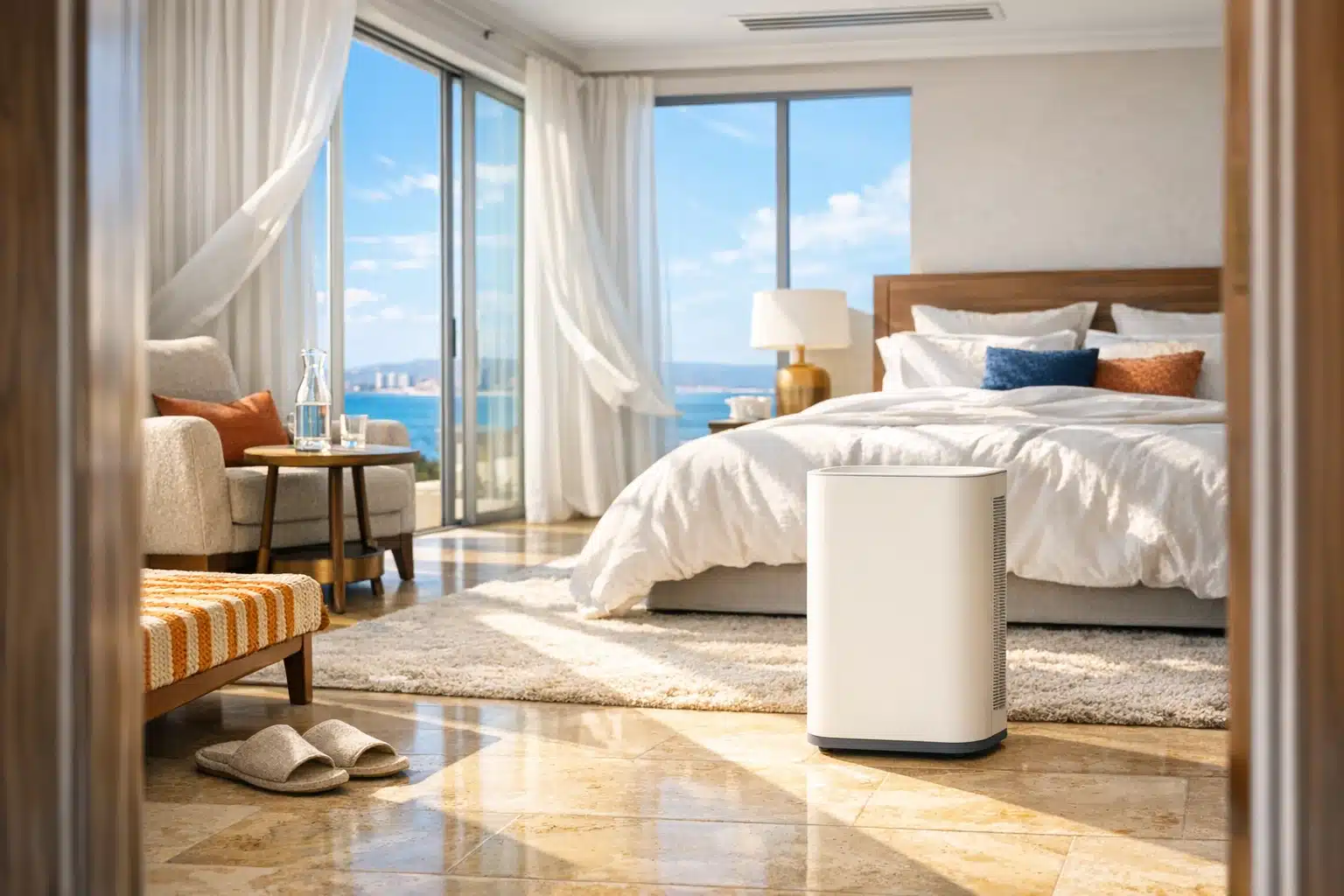
Placement matters more than many buyers expect. A purifier hidden behind a chair, pressed against a wall, or parked under a shelf cannot pull air as efficiently. Most units benefit from open clearance around the intake and outlet. Putting one near the center of activity, or at least where air can circulate freely, usually beats tucking it into the quietest corner. In bedrooms, many people place the purifier several feet from the bed so the clean air stream mixes through the room without blowing directly at the face all night.
Use habits also shape results. For dust, steady operation is usually better than occasional bursts. Running a purifier continuously on low or medium often keeps airborne particles lower than turning it on only when the room already feels stale. That is because dust is always being generated. Every blanket shake, every dog sprint, every opened window, and every heating cycle adds a new layer to the story.
Keep these practical steps in mind:
• Size for your real room, and size up if the space is open to other areas
• Prioritize bedrooms and the room where you spend the most hours
• Keep several inches of clearance around the purifier intake and outlet
• Run it consistently rather than only during cleaning sessions
• Pair it with regular vacuuming, bedding care, and HVAC filter replacement
It is also worth remembering what a purifier cannot fix. If your room is loaded with dust because of old carpeting, neglected vents, or outdoor air entering through gaps, the purifier helps but does not erase the source. The best results come from layering solutions: vacuum with a sealed machine, clean textiles, reduce clutter that traps dust, and let the purifier handle the airborne share that would otherwise keep circulating.
Final Recommendations: The Best Choice Depends on Your Home, Budget, and Patience
By the time most people start shopping for an air purifier, they are already annoyed. The shelves collect a new film too quickly, the bedroom feels stuffy, or allergy symptoms seem worse after a busy day indoors. That frustration is understandable, but it also pushes buyers toward exaggerated promises. The truth is calmer and more useful: a well-matched purifier can make a noticeable difference with airborne dust, but only when it has the right capacity, runs consistently, and receives proper maintenance.
Maintenance is where many good purchases quietly fail. Filters fill up. Pre-filters collect hair and lint. Sensors get dusty. If replacement filters are hard to find or surprisingly expensive, even a strong purifier becomes less attractive over time. Before buying, check how often the manufacturer recommends replacing the main filter, whether the pre-filter can be cleaned, and what the likely annual operating cost will be. Energy use also matters if the purifier will run daily, which it probably should. An efficient unit that you can comfortably leave on is often better than a more powerful machine you keep switching off.
Common buying mistakes are easy to avoid once you know them:
• Choosing by maximum room-size claim alone
• Ignoring filter replacement cost until after purchase
• Overvaluing smart features and undervaluing airflow
• Buying a tiny purifier for a large open room
• Running the purifier only occasionally and expecting constant results
So which type of buyer should choose what? If you live in a bedroom-sized space or small apartment and want a reliable all-rounder, a medium-room model like the Coway AP-1512HH or a similar unit with solid CADR is often the sweet spot. If you enjoy app control and want schedules, reminders, and easier monitoring, a model like the Levoit Core 400S makes everyday use smoother. If your priority is a quiet machine for a living room or bedroom where aesthetics matter, Blueair’s better-known midrange units are appealing. If budget matters most, a value-oriented Winix model can offer strong practical performance. And if your space is large or open plan, step up to a larger-format purifier rather than expecting a compact unit to punch above its weight forever.
For the target audience of this guide, the smartest decision is not chasing the most expensive device. It is choosing enough airflow for your room, a filter system you can afford to maintain, and a design you will keep running day after day. Dust is persistent, but so is a good purifier. Give it the right room, the right placement, and the right routine, and it can turn that glowing sunbeam from a tiny storm back into plain morning light.